- Bone marrow pathology
- Nodal and extranodal hematopathology
- Flow cytometric immunophenotyping
- Peripheral blood smears
Hematopathology Fellowship
The Division of Hematopathology at Northwestern University Feinberg School of Medicine comprises a collaborative team of ten core faculty members, including seven clinician-educators, two physician-scientists and one scientific director.
Our Hematopathology Fellowship program provides fellows with comprehensive experience across the full range of diagnostic hematopathology, including:
- Laboratory hematology
- Body fluids
- Cutaneous and pediatric hematopathology
- Hemoglobinopathies
- Coagulation studies
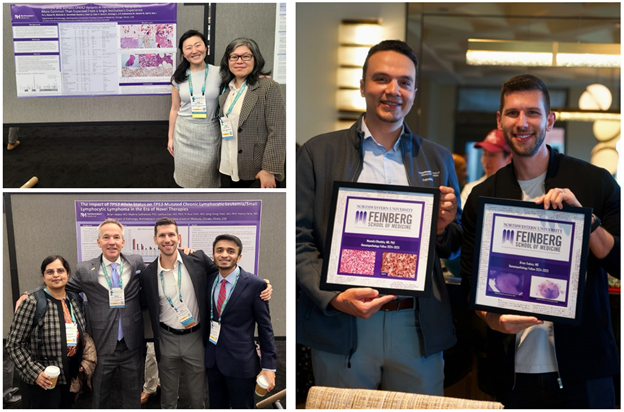
Alongside a substantial volume of clinical work, the division also conducts numerous high-quality basic and translational research projects, educational initiatives and quality improvement efforts. Our fellows are highly involved in all aspects of divisional operations, and as such, the program takes pride in its longstanding track record of training successful hematopathologists.
The fellowship is designed to provide highly motivated candidates with extensive hematopathology training at a state-of-the-art academic medical center in the heart of beautiful downtown Chicago.
Thank you for considering the Hematopathology Fellowship Program at the McGaw Medical Center of Northwestern University.
Fellowship Opportunities
Our fellowship program is participating in the 2027 National Resident Matching Program (NRMP) Hematopathology Fellowship Match for fellowships starting in July 2028.
For details on application requirements and the timeline, please see the How to Apply section below.

Associate Program Director
Associate Professor, Pathology (Hematopathology), Medical Education
About the Fellowship
Clinical Experience
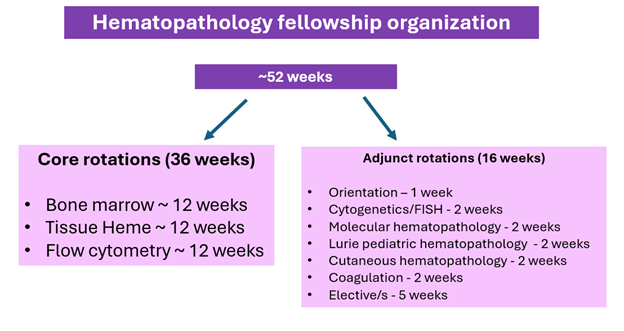
The fellows spend about 36 weeks of their fellowship on the three core rotations: bone marrow pathology, tissue hematopathology and flow cytometry. The fellows spend an additional 10 weeks in aggregate rotating through several ancillary rotations, including cytogenetics/FISH, molecular hematopathology, pediatric hematopathology, coagulation and dermatopathology. In addition, fellows are allotted about five weeks of elective time that can be spent in a clinical area of their choosing or on research activities.
Each year, the Hematopathology division receives about 2,000 in-house bone marrow biopsies, 1,100 in-house tissue specimens, 1,200 second-opinion referral cases, 4,200 in-house and 2,500 outside flow cytometry cases, 7,500 peripheral blood smear reviews, 3,900 hemoglobin electrophoresis evaluations, 1,100 body fluid reviews and 450 Sézary cell counts. The hematopathology fellows play a central role in all clinical services. They also work closely with the clinicians, acting as consultants to housestaff and attending physicians and as mentors/teachers/consultants to pathology residents.
Curriculum & Conferences
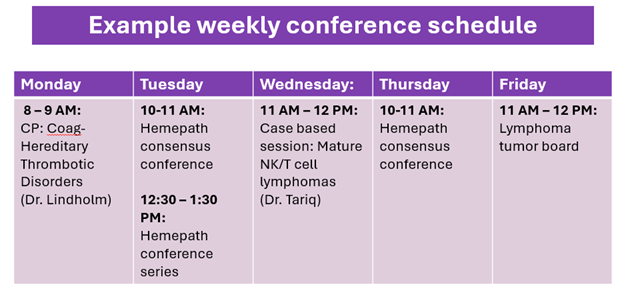
The fellowship provides a structured, year-long educational program for fellows, including lectures, case-based teaching sessions and unknowns sessions. Fellows are required to present cases at multidisciplinary conferences and deliver scientific or educational presentations throughout the course of the year. In addition, fellows participate in the twice-weekly hematopathology consensus conference, where attendings discuss their challenging cases.
Didactics
- Hematopathology fellow didactics: Wednesdays, 11 a.m. to noon
- Resident clinical pathology cases and hematopathology lectures: One to two times per month, Mondays or Fridays, 8 to 9 a.m.
- Fellows' career development seminars: Nine per academic year, Thursdays, noon to 1 p.m.
Consensus Conference
- Hematopathology consensus conference: Tuesdays and Thursdays, 10 to 11 a.m.
Multidisciplinary Conferences
- Lymphoma tumor board: Fridays, 11 a.m. to noon
- Hematopathology conference series: Tuesdays, 12:30 to 1:30 p.m.
Educational & Scientific Presentations
- Journal club presentation: One to two per academic year
- Cytogenetics/Molecular case presentation: One per academic year
- Fellows' unknowns teaching session for residents: One per academic year
- Quality improvement project completion summary: One per academic year
Research & Quality Improvement
Fellows must participate in hematopathology-related research projects in collaboration with hematopathology faculty and are encouraged to present their data at national conferences and publish in peer-reviewed journals. At the beginning of the academic year, fellows are presented with various research ideas and opportunities. Once fellows decide on their project(s), they are encouraged to submit their research proposals to obtain departmental research funding. The fellowship program has a strong history of producing high-quality manuscripts that are first authored by our fellows.
Recent Fellow Publications
- Vadasz B, Zak T, Aldinger J, et al. "Accelerated" chronic lymphocytic leukemia/small lymphocytic lymphoma (CLL/SLL): unraveling the biological gray zone of CLL/SLL in the era of novel therapies. Virchows Arch. 2025;486(4):739-750. doi:10.1007/s00428-024-03920-7
- Elhodaky M, Duckett D, Santana-Santos L, et al. Clinicopathological and global methylation profiling of acute myeloid leukemia with mutations in NPM1 and clonal hematopoiesis-related genes. Leuk Lymphoma. Published online April 25, 2025. doi:10.1080/10428194.2025.2495105
- Zak T, Santana-Santos L, Gao J, et al. Prognostic significance of copy number gains of MYC detected by fluorescence in situ hybridization in large B-cell lymphoma. Leuk Lymphoma. 2024;65(1):26-36. doi:10.1080/10428194.2023.2264429
Fellows must also complete a quality improvement project of their choosing during the academic year and present their completion summary in May before graduation.
Recent Fellow Quality Improvement Projects
- A lean workflow for complex hemoglobinopathy workup in the hematology lab (Taylor Zak, MD, PhD, 2023–24)
- Whole Slide Imaging for Multidisciplinary Tumor Boards: Reshaping a Lymphoma Conference at a Large Academic Medical Center (Brian Vadasz, MD, 2024–25)
- Digital hemepath fellowship guidebook (Mostafa Elhodaky, MD, PhD, 2024–25)
Other Fellowship Requirements
- Fellow In-Service Hematopathology Examination (FISHE): Take part in the FISHE exam twice per year, in the fall and spring.
- Patient Safety/Risk Management activity: File at least one Quality Improvement Report or Northwestern Event Tracking System report and participate in a simulated patient safety session.
- Proficiency testing: Take part in at least one College of American Pathologists (CAP) proficiency testing.
- CAP inspection: Take part in a mock CAP lab inspection
- Bone marrow biopsy procedures: Perform five biopsies per year and log in the ACGME procedure log
Stipend & Benefits
The stipend is commensurate with the fellow's Postgraduate Year (PGY) of training. Find stipend information via the McGaw Medical Center of Northwestern University site.
Hematopathology fellows receive:
- 20 days of required paid vacation annually
- 10 days of paid sick leave annually
- Five educational days annually
- $3,000 for travel and book expenses, with an extra $3,000 available for fellows with an accepted research proposal to support research projects, publication fees and travel expenses
Requirements
Candidates must be enrolled in an ACGME–accredited clinical pathology (CP) or combined anatomical pathology (AP)/CP residency program in the US. Combined AP/CP training is preferred.
How to Apply
Key Dates
Our fellowship program is participating in the NRMP Hematopathology Fellowship Match. An approximate application timeline for fellowships starting in July 2028 is as follows (exact dates may change):
- Nov. 30, 2026: Application submission deadline
- Dec. 1–15, 2026: Selected applicants will be sent interview invitations
- January 2027: Interviews will be conducted virtually
- February 2027: Registration opens for pathology fellowship match
- March 2027: Ranking opens for hematopathology fellowship match
- Early April 2027: Rank order list certification deadline
- Late April 2027: Match reveal
- July 2028: Fellowship begins
Application
Prepare an application form with the following items:
- CV
- Personal statement
- Three letters of recommendation (must come directly from referees)
- USMLE Step 1, Step 2 and Step 3 scores
Submit the application package via email to hemepathfellowship@northwestern.edu by Nov. 30, 2026, for consideration.
Why Northwestern?
Housestaff training through the McGaw Medical Center of Northwestern University provides diverse and challenging clinical experiences and world-class education located in the heart of the beautiful city of Chicago.
Watch a video to learn more about the fellowship experience at Northwestern: